The green takes over.
Waste and excess nutrients settle into stagnant, packed substrate, and light does the rest. Within weeks the glass, rocks and leaves are coated, and scrubbing only buys a few days.

The Modular Planted Floor system
Algae happens. Lifting it out takes a minute.
Every plant sits in its own lift-out module. When algae shows up, a plant melts, or you simply want a change, you take that one piece to the sink, rinse it, and put it back. Nothing else in the tank moves.
The three reasons people quit
It fails in three quiet steps. If you have set one up, watched it turn green, and felt like you did everything wrong, you did not. The floor was working against you the whole time.
Waste and excess nutrients settle into stagnant, packed substrate, and light does the rest. Within weeks the glass, rocks and leaves are coated, and scrubbing only buys a few days.
Loose substrate shifts, roots never anchor, and the airless pockets underneath quietly turn sour. The plants you paid for melt into the water column instead of filling in.
Fixing any of it means uprooting everything: a muddy, exhausting teardown that spikes your parameters and clouds the water. It is the moment most people decide fishkeeping is not for them.
Every one of these ends the same way: pull everything out and start again. Unless the floor comes out in pieces.
The whole system, in one move
There is no separate cure for algae, for a melted plant, or for a layout you have grown tired of. There is one move, and it answers all three.

Step 01
Slide one module out. The plants, the roots and the substrate all come with it, held together in one piece. The rest of your aquascape does not know anything happened.

Step 02
Clean it at the sink. Trim it, replant it, or swap it for another. The algae leaves with the module instead of being scrubbed across the whole tank.
Step 03
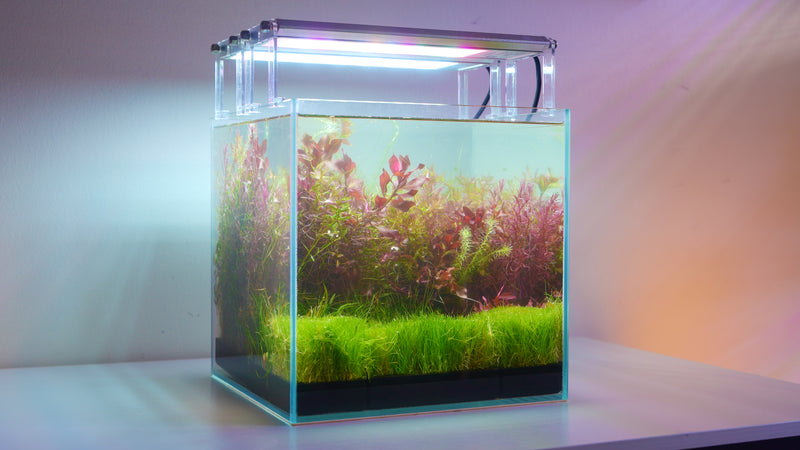
Drop it back into place. The floor closes up, the carpet grows back over the seams, and the scape looks the way it did before, minus the problem.
And if it ever gets really bad? Lift them all. A complete reset, without uprooting a single plant.
What actually changes
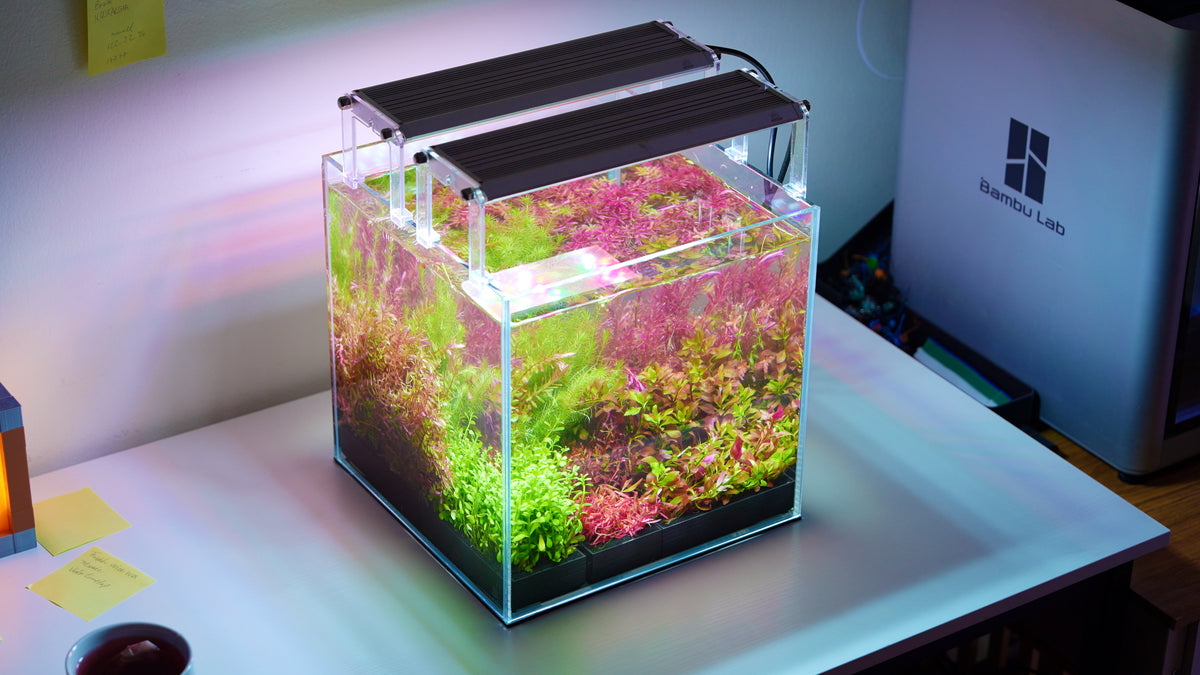
That is the real difference. Not that algae never appears, because it does, in every tank, including these. It is that algae stops being a disaster and becomes a two-minute job. Once a problem is that quick to undo, you stop hesitating. You try the hard plants. You rescape when you feel like it. You keep going, which is the only thing that ever made anyone good at this.
Start with the free kitStart today
Every product here is live right now. Start free, then take the full set whenever you are ready.
Nine module files across three footprints and all three heights, plus a PDF layout template. The no risk way to try the system.
Nine printable module sizes in the H30 height, plus a 46-page tank layout guide.
All nine sizes in H30, H38 and H50: 27 printable files for every planting depth.
Before you ask
No, and be suspicious of anything that claims it does. Algae turns up in every planted tank, including ours. What changes is what it costs you. Instead of a weekend teardown, you lift out the affected module, rinse it in the sink, and put it back. The problem leaves with the module rather than being scrubbed across your whole aquascape.
Almost never. One module is usually all it takes, because problems tend to start in one area. But if a tank really gets away from you, you can lift every module out, clean them all, and set them back down. That is a full reset without uprooting a single plant.
For the digital products, yes, or access to a print service. The files are print ready STL. Printed, ready to plant kits are in small batch production and are not on sale yet. Start with the free kit to see whether the system suits your tank.
Today the printable version comes in nine sizes, from Small 70 by 70 mm to Jumbo 210 by 210 mm, in three heights, and the Tank Compatibility Guide shows layouts for common aquariums. The complete Modular Planted Floor, in development, is made as a fitted floor for four tanks: the 30C, UNS 45U, ADA 60P and UNS 60U.
With the printable version, your own: the module holds whatever aquasoil, sand or gravel you prefer. The complete Modular Planted Floor uses aqua soil under a root sponge.
Far less than a normal rescape. You are removing one contained piece rather than digging through the substrate bed, so very little clouds the water and your parameters stay stable. Move slowly and give the tank an hour to settle, the same as any maintenance.


